








Unit-Based Oil Handling Interfaces for Structured Pharmaceutical Programs
Upstream preparation tools designed to support repeatable volume structuring
— without performing drug delivery or patient administration.
Quantara products are not drug-delivery devices and do not define therapeutic dose.
Industry Context
When Formulation Advances Faster Than Delivery Platforms
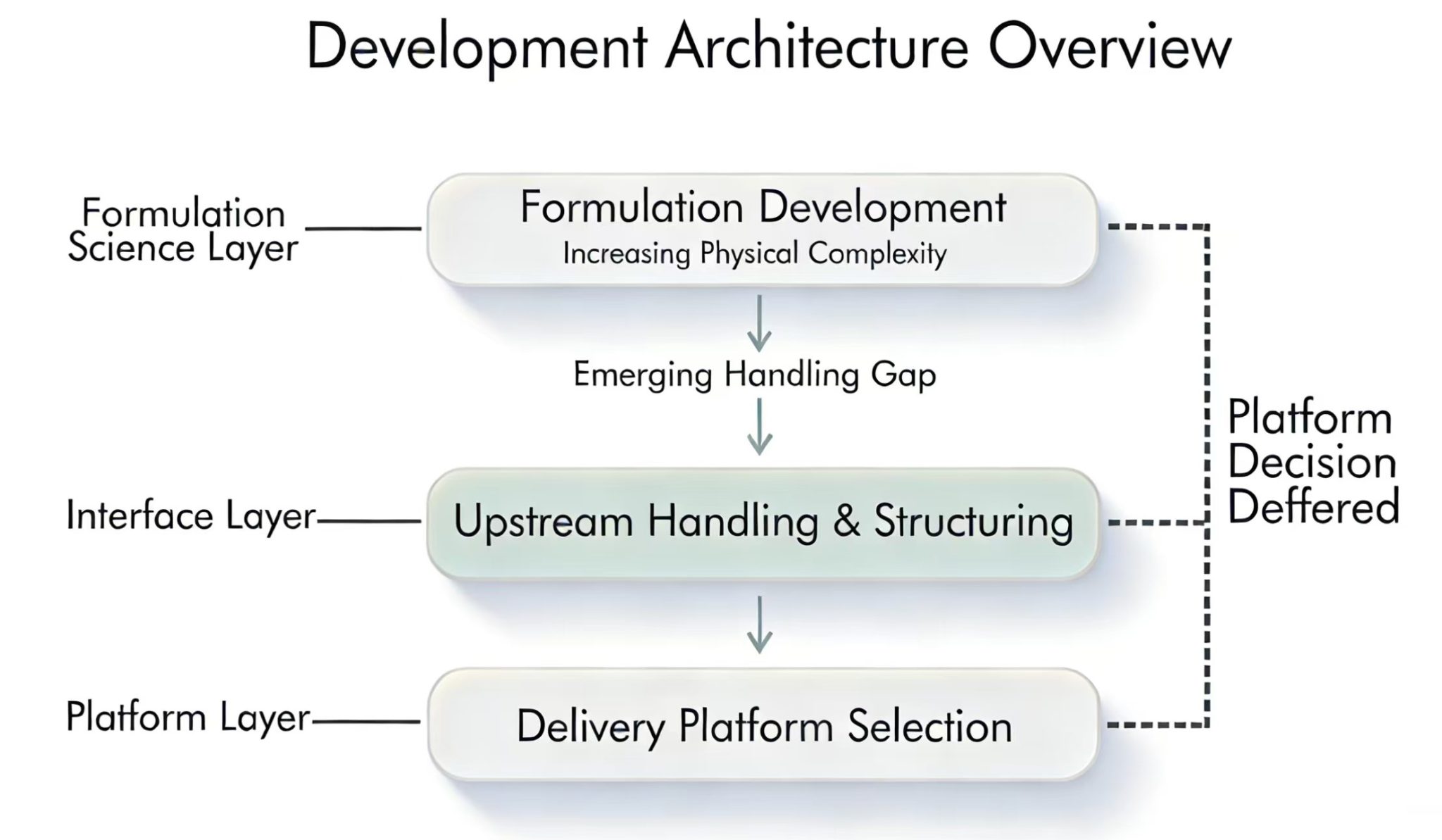
Many modern pharmaceutical formulations — including lipid-based, oil-based, and other non-standard physical forms — exhibit high viscosity and handling challenges that are not well addressed by legacy delivery platforms.
In such programs, delivery method selection is often deferred due to regulatory risk, platform lock-in, or development cost.
This creates a recurring upstream gap:
materials must be handled and structured before administration decisions are finalized.
What Quantara Is
- A unit-based handling interface for oils and semi-solid formulations
- Positioned upstream of drug administration
- Designed for repeatable volume structuring, not dose delivery
- Platform-agnostic by design

What Quantara Is Not
- Not a drug-delivery device
- Not an injection system
- Not a dosing or therapeutic accuracy device
- Not patient-facing administration equipment
This boundary is intentional and foundational to Quantara’s role in regulated programs.
Industry Trend: Increasing Formulation Complexity
Pharmaceutical and specialty formulation programs are evolving toward increasingly complex material systems.
Across multiple therapeutic areas, development teams are working with:
- High-viscosity biologic preparations
- Lipid-based and oil-based APIs
- Semi-solid or suspension-like materials
- Non-aqueous or structured liquid systems
As formulation complexity increases, interaction control becomes a structural variable — not a purely operator-dependent event.
Traditional liquid handling approaches often rely on continuous, free-motion manipulation.
In high-viscosity or structured systems, such variability can introduce:
- Handling inconsistency
- User-dependent interaction differences
Process-level variability across teams or environments
Quantara focuses on the interface layer — introducing mechanical structuring where interaction repeatability matters.
Why Interface-Level Structuring Matters
In conventional handling methods, material transfer is typically governed by continuous motion control.
This approach relies heavily on user behavior and real-time adjustment.
A unit-based interface architecture introduces discrete mechanical structuring.
Rather than depending on free-form manipulation, the interaction is defined by:
- Controlled mechanical indexing
- Constrained interaction geometry
- Repeatable engagement logic
- Platform-level structural consistency
This does not replace formulation science or device systems.
Instead, it introduces an upstream interaction layer that reduces uncontrolled variability before downstream program integration.
Quantara is designed to function at the interface level — upstream of delivery systems and independent of therapeutic performance claims.